Showing posts with label My experiences. Show all posts

Tuesday, 24 May 2016

GETTING IN TO DRAMA SCHOOL

This is by no means a bragging post, but just a quick and very exciting one to say that I got into drama school this year! I am very excited to have received a place at GSA on their BA acting course ready to start this September. 
This has been a very interesting year for me, as it was a big step to admit that university was not the right path, and pluck up the courage to take another year to do what was in my heart. We are raised in this culture where university seems to be the norm, and anyone who tries to stray from that is almost alienated. Having an already confirmed place at university last year, it was a huge thing to decline, and enter a world outside of education, very last minute, with no money, and have another crack. 

Living a year at home has been quite challenging, especially living so far from London, where a lot of auditions take place. Not only that, but I live in a very small town where there isn't a huge amount of theatre culture, and it's very easy to feel quite isolated from what you are trying to achieve. I urge anyone who takes a gap year and lives in a similar place to me, to surround yourself with culture: watch videos, live streamings, read books and plays, and keep your mind active and remembering what you are trying to achieve. Through doing this, I have learned so much and become a much better informed person. I have also had to push myself to get involved in local groups and theatres which has lead to me landing the main role with my local theatre royal group, and becoming a director at my local theatre group. All of this has meant that I have become more confident in myself as an actor, and I was able to go into my auditions this year with the mentality that I deserve a place. There is definitely something about being out of education and having time to fill yourself, that gives you a certain confidence, as you are forcing yourself to get involved in new things, otherwise you would just be bored. I urge anyone who has failed to get into drama school to take some time to relax, and reflect, and find new ways to inform yourself and nurture your talents. Trust me, it will go SO FAST that you almost want to take more years to find newer and bigger things to get involved in. I can finally understand those people who take years and years to get into drama school and never lose their passion. If you want it enough, you will always get there. 

I cant wait to begin training, and continue my blog throughout (I hope) to keep a track of all the wonderful things i'm learning, and hopefully help other people interested in training. 

Art Scene festival - Ghent

Last month I was very lucky to go to a theatre festival in beautiful Ghent, Belgium, to showcase a play that I directed. A few months ago, I wrote a post about the fact that I had the opportunity to be the assistant director of a show for the national theatre connections competition, talking about how much of an exciting opportunity it was, and how you should push yourself to do things no matter how little they are. 6 months down the line, and this role has given me more than I could have hoped for, being performed at many different venues all leading us to this wonderful youth theatre festival in Belgium.
The Art scene festival was four days long, and was comprised of youth theatre groups from all over the world coming to perform a short 40 minute show, performances of which were spread across the few days.
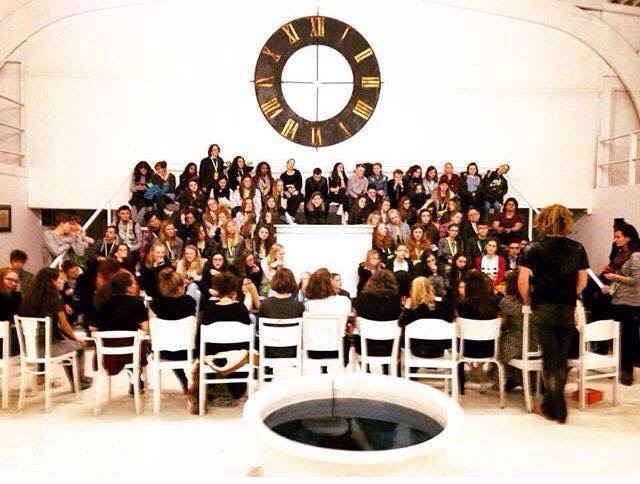
There were workshops run by professionals every morning for the kids to take part in, and after lunch, we would all watch about three/four shows. The amazing thing was that the festival is held in a beautiful theatre in Ghent called the Tinnenpot which has multiple theatres within the building, for example a standard tiered seated auditorium, a circus space with seating in the round, black box spaces, balcony theatres, and most interestingly, an all while theatre space. This meant that we could see the shows in all different spaces, and experience so much in a day without even leaving the building. At the end of the day there was then a huge forum where everyone sat and asked the cast and directors of each show all about the rehearsal period the general creative process. It was such a wonderful thing to see so many people from all different countries coming together through theatre.


It's not just the wonderful experience of the festival that made me want to write this post, but actually the fact that I was given this experience because I pushed myself. This all began with me trying something a little different by becoming an assistant director at my local theatre group, which wasn't massive. But slowly, I began to take on a bit more responsibility within the group, teaching them ensemble exercises and establishing ensemble workshop rehearsals. The main director and I became very collaborative in the process, until I was running rehearsals on my own . Sixth months from when we started the project, we have performed in many different venues, finishing our run at this festival in Ghent. Whilst being there I met with a lot of the other directors and organisers of the festival too who found what I do with the group very interesting, and now I have even been asked to come and work on the English equivalent of the festival to be a workshop leader. When I first started directing, I wasn't sure I had enough experience to be of use, yet once I started to set my mind to keeping track of all of the ensemble exercises I was taught at the National Youth theatre, or at drama school auditions, I realised I could construct useful workshops of my own, taking exercises from different places, or adapting them in some way. As long as you deliver everything with absolute confidence, and a strong idea of what you are trying to achieve, you are set. I think this festival was the pinnacle in me realising this, and the capabilities I had when speaking with different directors. I also found myself teaching a lot of the kids attending the festival lots of concentration games, and after two days, I has all of them playing them in the breaks of their own accord, and really enjoying them, all because I was confident enough to believe they could be of benefit. 


I thank festivals like this, that can enrich young people by allowing them to travel to different countries and showcase their work, and help us to realise that theatre has no language. It was so much fun to see the kids in my group experiencing different cultures for the first time, and mixing with young actors of all nationalities, who were all united through their work. 


Tuesday, 5 April 2016

Love and Money - Denis Kelley, Norwich Theatre royal Youth company


I'm very happy to have been part of this wonderful production with the Norwich Theatre Royal Youth company. The part of 'Jess' in Dennis Kelly's 'Love and Money' has been a very big part to be trusted with, and in the process of this show I have gained a lot of confidence, been pushed out of my comfort zone, and broken a lot of emotional barriers. I urge anyone to join new groups, expand your circles and try new things!

Monday, 14 March 2016

National youth Theatre audition masterclass week/preparing for auditions

This post comes a little later than I had first hoped, as I attended one of The National Youth Theatre's audition masterclass weeks on the week beginning 15th February, however with a couple of drama school auditions in between, and a lot of rehearsals etc, it's a few weeks since I did the course. None the less the course was very valuable and is worth a post giving a summary of the week.

Working on your monologue
- Back to the basics: I wouldn't say the course necessarily taught me anything I didn't know before, yet it did remind me that it's never too late to take it back to the basics with a monologue. When I started the course I had a bit of a mind block with all of the four monologues I had been working on for drama school, and couldn't work out why they weren't coming along as well as previous years. Throughout my life I have been very used to working on monologues as I started doing LAMDA exams when I was eight, but since I've been older, and working on monologues on my own without the assistance of a teacher or tutor, I have been a little lost. On the first day of the course we were made to sit down and write the answer to a whole list of questions, all of which were very basic Stanislavsky based questions, which helped you to create a whole back story for your character. These included questions that you may not know the answers to and ones which you are free to make up. For example how old are they? What class? What is their occupation? What is their life story up until this point? The occupation of their parents? Some of these may seem irrelevant, but it honestly helps you to get into the whole mindset of your character, rather that just their mind set in the speech. Then questions to do with the play were asked, for example what has happened in the play up until this point? The scene previous? The line previous? What is their super objective (what they want to achieve in the whole play?) and what is their objective in the monologue? This allows you to get a feel for everything you are feeling at the moment of your monologue, but also of everything your character has been through up until now. Once you have been through all of these questions you can then look back at your monologue and decide whether the answers to all of these questions might affect the way you say a line. You might realise why they are saying something when you hadn't realised before, or you might have decided something has happened in their life that makes your character speak in a certain manner, are they an angry or calm person etc. This is all preeeeety basic stuff, but sometimes, if your having a mind blank, it can help you find new units in your monologue.
- Playing with tone: Again, all of this is very simple stuff, and a lot of drama teachers will make you do these exercises when working on any monologue, but quite often there is a reason for that. We did an exercise I've done many times which involved doing your monologue in different styles and often ones which are a total contrast to the tone of your piece. For example doing the whole piece as if you are addressing a class of children, as if you really need a wee, as if you want to have sex with the person you're talking to etc. I read once that your monologue is like a whole play in two minutes, and in order to keep your audience engaged, you have to change the tone after every line. This exercise helped me to find those levels and places where tones which seem like they wont actually work, fit well. My monologue was Paulina from the winters tale, and although the overriding tone of the piece is anger, I found that doing it as if I was talking to a load of children brought out a patronising tone which actually really worked to undermine the character I was talking to. Doing the piece as if I needed a wee also made me hold back my anger which totally worked at points too. This meant that I could go through my monologue more intricately and find even more levels.
Other basics covered were simple things like looking at punctuation and really using it (especially in classical writing) as well as stressing particular words, not sounding like you're about to say a list when you begin a list, not letting a thought take an hour to come, but at the same time not rushing. Taking all of this into account allows for you to get the initial body of your monologue.

Interview technique
- Something which I really learned to do with Interview technique was that BODY LANGUAGE MATTERS MORE THAN ANYTHING. Apparently genuine scientific experiments have been conducted to find out what affects a person in an audition the most, and nearly sixty percent of the panel's initial judgement of you lies in your body language. If you seem too chilled or too nervous and tense they may not believe you to be serious enough or strong enough for drama school training. If you're posture isn't straight they may think you're not confident in your body as you have to shrink back (something that i'm guilty of). If you're not smiling they may find that you're not happy to be there or even that you're not a friendly person. It is all of these things that a panel notices first and then its what you say and how you act which comes next. This has made me very conscious of how I walk into any audition room for the first time.
- Another thing that we worked on was your actual interview technique and how you answer questions. The facilitator of the course said that from her experience of leading interviews it all comes down to time, and a person that can tell them everything they need to hear in response to a question is a good candidate. Short answers suggest you're uninterested and can be frustrating for a panelist if they are trying to find out things about you quickly. In saying this, going on too long with your answers and not sticking to the point can be just as irritating as not answering at all, as you may not have even given them the information they asked for. In an interview situation, the best thing you can do is answer the question in as much detail as you think is needed without straying from the point. Other things we learned to be effective when being interviewed is to find common ground with the person interviewing you, or relating to them in some way, engaging them: a good thing to think is what can you do for the panel? What do you think you have which can make their day better? Never apologise for yourself, don't say sorry i'm waffling or even sound sorry when you say hello, stay confident in everything you say and know that you deserve to be there.

Motivation
Most importantly, I found the week long course to be really motivational. When you're taking a gap year as I am, it's really easy to forget how many people are working for what you're working for, especially if you live somewhere out of the city or out of London, and you're not constantly surrounded by people who are doing the same thing. Most people in the town that I live in don't know what drama school is. Going away to London for a week and surrounding yourself with like minded people is one of the most motivational things you can do, and it gets you in the mindset. It also just made me do the work needed. If I had taken a week off work to work on my monologues I would never have worked on my technique as much as I did at NYT and I'm so grateful to have done it. It gave me a massive kick up the arse to work hard when i'm at home and most importantly, introduced me to a whole new bunch of awesome people just like me. It reminds you that you're not alone in all the stress and preparation.

NYT Rep Recall

My previous post describes my National Youth Theatre annual casting. As a result of this audition, I was invited to a recall audition for NYT's Rep company, an eight month long free training course which finishes with a three month run of shows at the Ambassadors Theatre (or a theatre similar). I was majorly excited to be recalled, as this is one of the most prestigious things NYT offer to their members, and so many audition each year. As with a lot of recalls, this was a very fast paced process, and I was contacted just a week after my casting audition that I had a recall for that week. The next two stages after this one would also take place the following week!

When auditioning with NYT I always feel a lot more at ease in comparison to drama school. I think It's because there is almost always someone you know there, and the staff that work for NYT are so nice and just want you to do well. I said how in my first audition, it felt very conversational and friendly, and I was put at ease to see that Anna who initially auditioned me was also leading the recall.

The session was three and a half hours long and first consisted of a warm up with two members of the previous year's rep company. We played a simple 'in the pond, out the pond' game, and then moved on to generic concentration walk around the space stuff. This lasted about 40 minutes, and then we moved on to character work-shopping. We had to find a space and tune into our characters, and think about our whole back story: who we are, our age, our life story etc. Then we had to tune into our monologues and think exactly where it was taking place, what time of day it was, how your character is feeling and what has happened right before the point that your character begins to speak. We were asked to have these answers in our heads and then Anna, the facilitator of the recall came around to ask us the answer of these questions, and we had to answer in character. What I did is not recommended however, as I answered these questions in my head and then when she came to me, I answered the first two and then went totally blank. Although I tried hard to stay in character, however I feel she could sense my inner monologue of shit fuck shit shit shit shit...After she had been around everyone, we were asked to keep our thoughts and the feelings present and find a sitting position, still in character. Then each person's name was called and we were to launch into our monologues from there. This was a very basic exercise, but logistically was very difficult. My character, who's feeling extreme anger right at the point of the beginning of her monologue, and has just witnessed the Queen, her best friend, die, the feelings I had to hold here were very intense, especially seeing as I was one of the final people to perform out of about 20 or more. During this hour or so of holding our characters there was also the added pressure of hearing everyone else's monologues before your own, and deciding whether or not you should react, especially when people walked around and looked at you. I felt more pressure when there were funny monologues, as I had to hold back from laughing because it didn't adhere to my character's feelings at that point. Should I have let go, I was worried I would be called to perform and not be in the right emotional place to launch into anger.

After about an hour of hearing monologues, we were given a ten minute break and then we launched straight into finding the place for our second character, answering the same questions. Having chosen my angrier character first, I was relieved to take on a much more calm and inquisitive disposition. We were asked to find a seated position once again yet around the perimeter of the room instead, and this time we were free to walk into the middle to perform. A specific thing that was asked from the panel is that you recognise your audience, and this time, where in the first hour I ignored everyone else and focused on myself and the man I was speaking to, I eased up and looked at everyone in the room, as the nature of my monologue was sort of questioning human existence. One guy even used another guy in the room for the whole of his monologue so to include a member of the audience into his speech. Whilst others were performing their monologues I also allowed myself to listen and react according to how my character feels towards the issues discussed in each monologue. I felt like seeing as I took the opposite approach with each character, one of them must have been acceptable. This was all the recall consisted of, and although what we were asked to do was very simple, it was one of the most challenging things iv'e had to do as it meant holding a character in one place for such a long time.
I wasn't recalled after this stage, but all the same I took a lot away from this recall day, and I think auditioning for the Rep company is something I would really love to return to.

Thursday, 10 March 2016

National Youth Theatre casting audition/how NYT works...


The bulk of this post revolves around how my National Youth theatre annual casting audition went this year, but as an introduction I will explain a little bit about being a member of NYT if you don't already know.

You can audition for NYT at any age between 14 and 21, and once you are a member, you stay one until you are 26. I wont go too much into the details of the audition process, as that's a whole post in itself, but once you have undertaken a 2 week or 4 week acting intake course, you are then able to utilise everything NYT offer you. You are given a log in to their members website, which has a whole page external professional industry castings which aren't always advertised to the public. Then there is a page dedicated to everything NYT are offering across the year, for example audition technique master classes, research projects, free tickets to shows etc. To get a part in one of the shows NYT put on for each year, you have to do a day-long annual casting audition, which I am writing about in this post. If you get cast, it is very like on a big stage to an audience of industry professionals, and therefore this annual audition can be majorly important.

The group gets split into two at the beginning of the day. Half of you get to perform your monologues first, and the other half get to do a physical workshop and vocal workshop. If you are lucky you get to do all of the physical and vocal stuff first, which I always feel gets you in the mindset to perform your monologue. As with anything with NYT, the day was very friendly and informal. At the end of the day, they know you are already capable, and just want you to do your best. At no point in the day, did I ever feel like I was being judged, as everyone who works at NYT is totally chill and friendly.

I was one of the lucky ones who got to do the physical bits first, starting with a movement workshop. This consisted of a few ensemble games, for example passing the clap around the circle, and walk around the space concentration stuff (we've all been there). Then we had to get into partners, and work on making our body passive, semi passive and active. This was all to do with control and the confidence to trust and work with another person using your body. In this exercise, your partner had to mold you into different shapes, and if you were passive, you have to let all of your muscles flop and you would fall to the ground if your partner wasn't there to catch you. Semi passive meant you were slightly tensed and you could help your partner slightly, and active was physically moving yourself, trying to get away from your partner. It was mainly experimental and was a good way of seeing people's flexibility, but also their willingness to let their body be manipulated. This exercise was developed further, as we were put into groups, and given a situation which we had to act out using the ideas of passive, semi passive and active. My group was given 'first dance at the school disco' and we all had to explore and decide how you would act if you were in this situation: you might be active and run away because you are scared, or faint of embarrassment which would be passive. We then performed these to the group. The other main section of the workshop was to see how physically able we all were. Kayne, one of the main choreographers at NYT who lead the workshop always puts on really loud fun music, and then demonstrates movements that he wants us to do across the room. These consists of jumps, leaps and kicks, all things which allow him to pick out dancers and really see people's confidence in their bodies. If you're not a dancer, there is no need to be scared about this however! NYT always make a strong point of reassuring everyone that its not a test of your dancing or singing skills or anything like that, it's just to see how free and confident people are with their bodies. I always really enjoy these workshops, and I think that's a good key to doing a strong audition, because it shows your willingness, and that ultimately, you love what you do, no matter if you're balls at dancing.
The second half of the morning was a vocal workshop which was similarly structured: a few warm ups, like scales, humming and facial stretches, as well as a song circle kind of thing. This was a way of letting everyone have their opportunity to sing a couple of lines of a song while everyone else clapped and laid down beats to keep it moving. Once again, some people who weren't very confident did a bit of spoken word, or rapped happy birthday or something, but once again as long as you were confident in what you were doing, it really didn't matter. On a personal level, I was really pleased we did that, as it put me under pressure to sing on my own, which I don't often  do, and I felt really good for it. After this we did some singing in sections, e.g altos, sopranos and bases, exploring rounds and choral sort of singing. We then finally were sent off into groups of about five, and we were all asked to put together a musical arrangement of any kind. As always with NYT, there were lots of different things ut together, and people who play instruments were invited to play in theirs. As for my group, none of us played any instruments and a couple of people weren't entirely confident singers, so we did a totally lame yet obviously outstanding mashup rendition of Justin Bieber's baby. Once again we enjoyed it and were confident and I think if you try your best to show everything you can do, then you've done well.

After the morning sessions, there is an hour lunch break and the two groups swap over. The monologue section is a lot slower moving, as each person is taken individually to audition, and if your nearing the end (as I always am) then you could have well over two hours to wait and prepare. I always take this time to meet some new people and have a good chat, as you never know what you might learn. For someone like me who doesn't live in London, it's great to make the most of the time to hear about plays that people have seen, or workshops or drama school auditions and all things like that, as its a whole hub of experience. Then when it's nearing my time to go into the audition room, I go through my monologue a little to prepare and do some meditation and stretchy related stuff to get me going. My audition this year was soooo much more relaxed than last year, as I felt so much calmer. Over the last year since I have done more shows and workshops with NYT I have come to realise that its a lot more of a friendly conversational place, where staff only want you to succeed. I therefore went into the room excited to chat to the facilitators about everything i've been up to this year. If you show them friendly confidence, they will give it straight back. I then performed my monologue: Paulina from 'The Winter's Tale' which is quite contrasting to my happy self, and generally l felt preeeety good. They just simply chatted to me about my gap year, where I work, what shows I'm in at the minute and just about any skills I have like dancing or singing etc, and that was it. It was just before six when I finished the whole day audition which started at ten. If your monologue is at the beginning of the afternoon however you could only be there until three.
All in all, this year's casting was one of the most enjoyable auditions i've done to date, and I cant wait to hear if i've been successful in this years season of shows :))


Monday, 29 February 2016

Jess - Love and Money By Dennis Kelly

This is just a quick post about the show that I am to be in next month, not only promoting it, but also to express how much I have learned playing the part of Jess in Dennis Kelly's 'Love and Money'.
For anyone who knows Kelly's writing, you will know it is a totally naturalistic and truly intricate style of writing, that completely captures each and every character in a slice of real life. Playing the part of Jess has been the biggest responsibility I have ever been given in a show, as although I have played lead roles, none have been quite so psychologically complex. I have learned to take my acting right back to the basics, creating a whole life story for Jess myself, and researching intensely on her type of mental illness so to capture her exact thought processes. It never hurts to try every line in a whole plethora of ways in order to capture just what works with a certain character, something which has definitely been no mean feat with Jess' concluding nine page monologue, yet definitely one which has taught me no end about this style. I would totally recommend reading and trying some of Dennis Kelly's work if you are someone that finds it hard to find the truth in your performance, as his style is so real! I can't wait to work even harder on this part in the next month.


Tuesday, 26 January 2016

HAVING A GAP YEAR AT HOME


A lot of people turn their nose up when I say that I am living at home during my gap year, and whilst yes, living at home can be a hard thing to endure, especially if all of your friends have gone to uni, or if, like me, you live miles away from anywhere remotely urban, there are still so many ways to make the most of your time. Over the past few months I have really learned to squeeze as much as possible out of my gap year, and really expand my artistic horizons. At the beginning of the year I felt like the only way to do this would be to go to London as much as possible to see contemporary shows, west end musicals, and take part in professional workshops etc, yet living as far away as I do, I soon realised that this was an unrealistic way of doing things. I found myself to be in a bit of a catch 22, because in order to get to London this much, I needed a job to pay for it, but with a job, you cant have as much time off as you please to be in London for weeks on end 'finding yourself'. Instead I have found so many ways to compromise and have a gap year that nurtures me just as much as if I were living in the heart of London. If like me, you're taking a gap year to reapply for drama schools, yet didn't opt to move out to London,or you couldn't afford a foundation year, here's a list of all the things I am doing to still try and gain as much knowledge as if you were out doing those things. 

  • Working/volunteering in a theatre: I was incredibly lucky with my job this year, as I actually work in a theatre, running the cafe and bar, and much of the front of house. When I began this year I had the idea that I wanted to try and work in a theatre or even volunteer to help with shows, but I never dreamed I would be working as a member of management, in an albeit small, but very modern and up and coming theatre. Being around the art means that you can most probably go and see as many shows as you please, thus helping to gain extra knowledge in theatre. Not only this, but I very often get to meet the companies who come to the theatre from other places, thus allowing me to make so many connections and opening up the possiblity to work with these companies in the future. You'd be surprised how many directors or actors start up converstaions with me (working behind the bar) and end the conversation by inviting me to come and work with them, or giving me their number. Even if its just volunteering in a theatre, being surrounded by like minded people is so stimulating and motivating.
  • Exploiting all medias: What I mean by exploiting all medias is making the most of everything that is available to you. I have recently discovered the medium of live streaming: when a professional show being performed live at somewhere like The National, West End theatres, or even Broadway, and is streamed to a different theatre or even cinema for audiences all over the country to enjoy. When I first heard of them, I thought it would be no where near like going to the theatre itself and actually watching the show, yet I found that the amazing quality makes for a similar experience. I can go to my local theatre on a week night and see talents like Judy Dench and Kenneth Brannah live for as little as a tenner. You can also find so many similar things online, for example youtube videos of full length performances by professional companies. You can also find so much on the tv, for example the evening of performances aired by channel four a few weeks ago which showcased live shows by three professional companies, or even the stream of 'Gypsy' live from the Savoy on the BBC, both of which are available on catch up at any time. You can also buy endless DVDs of performances. Just because you are not living in London or a big city, doesn't mean you don't have a plethora of amazing theatre at your fingertips to learn from.
  • Getting cultured: Getting cultured stems from exploiting all medias, but it not just watching amazing theatre that can make you a better informed actor. I have a big love for watching films, tv dramas and web series in order to see the work of as many amazing actors and directors as possible. Not only this, but reading books and plays, going to art galleries, seeing live music etc, are all things that can inform you about society and in turn help you to understand contemporary writing. This also allows you to come across many lifestyles and cultures which can only help you to portray them better on stage. Its also important to remember that you are doing these things because you love them (or at least you should), its not JUST because you want to get into drama school. It sounds ironic, but as soon as you begin to do these things for yourself and not just because its what a drama school wants from you, you become the interesting individual they might wish to take on.
  • Taking as many theatrical opportunities as possible: If you're taking a gap year in order to try again for drama school, this is quite an obvious one, but its important to highlight. Even if its taking a part in a amateur dramatic play, taking singing lessons, going to evening dance classes or even helping out with a local theatre group rather than acting, every little helps. Sometimes its easy to get caught up with work, but when you're in the middle of a long period of unfilled time, its easy to become unmotivated to better your technique if you are not stimulating yourself. Through taking every opportunity, no matter how small, I have landed the lead role in a very hard hitting play with my local theatre royal, am directing my own show to compete in the National New Connections competition, and I have a job right in the middle of everything I love. this is just after a few months, and I have so many more plans after my auditions to travel and expand my theatre knowledge internationally. Through constantly being involved with theatre I am always feeling motivated to work on my monologues and songs for auditions and better my technique because it reminds me of what I took my year out for. 
  • Keeping healthy: Being healthy is not necessarily connected to acting, but it can definitely make you a happier and more motivated person, which in turn keeps you motivated to always work on yourself. I don't only mean the obvious things like eating healthily, exercising, getting enough sleep and water etc, but keeping a healthy state of mind. Things like mediation, conscious breathing and yoga are all things which can help you to be a mentally stronger and calmer person, which obviously doesn't go a miss in an audition. A gap year is the perfect time to become the healthy person you've always wanted to be, and lets face it, drama school training is going to physically demanding and having that little bit of strength when you come to audition is only going to work in your favour. Getting fit and strong also shows dedication a staple drama school desirable. 


Saturday, 17 October 2015

Being an assistant director

,
This is my first post under the tab of 'my experiences', and hopefully one of many! This year I aim to do a lot of stuff around theatre, but most importantly, things that are a little different to what I am used to. This is simply a little post introducing the fact that I will be helping to direct a play for the 'New Connections 500' competition this year. A national youth theatre competition which sees over 500 companies compete for a chance to perform at The National. Even though I have worked with the Fisher Youth Theatre Group ALOT throughout my life, this is the first time that I will be taking more of a directorial role, and i'm really excited to do so, and push myself to do things out of my comfort zone. A few months ago I wouldn't have even thought of offering my experiences and knowledge to anyone, because I didnt think I had any to give. Then I put into perspective quite how much I have learned in the last couple of years, working with the National Youth Theatre, Alevel drama, drama school auditions etc, I realised you mustn't underestimate yourself. I cant wait to be involved in this project, who knows where it will take us!